- Sanskrit
- Adho Mukha Vrksasana
- In Russian
- Стойка на руках
- In English
- Handstand
A diagram cannot assess readiness
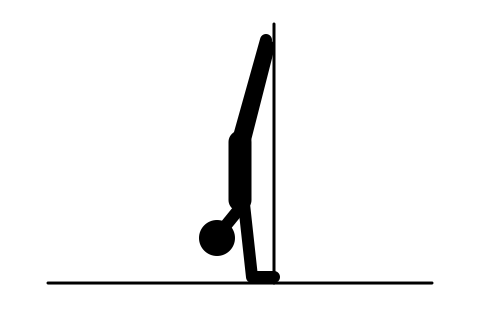
The illustration shows the name of the pose and the arrangement of the body. It cannot show how the load is shared between wrists and shoulders or explain an entry suitable for an individual. The wall in the diagram is a prop for the exercise and not evidence that the pose suits anyone.
Leaving out Handstand does not require another difficult replacement. You can remain in Downward-facing dog while the group explores inversions. Tell the teacher your chosen alternative in advance so you do not need to decide under pressure from the group pace.
How to do it
- If health restrictions apply, ask a doctor in advance whether inversions and loading of the wrists and shoulders are appropriate. Share that advice with your teacher: permission for an ordinary class does not mean readiness for Handstand.
- Begin with poses that introduce support on the hands: [Downward-facing dog](/asanas/downward-facing-dog) and [Plank](/asanas/plank). Stay in them briefly, with an even breath and soft elbows.
- Ask the teacher to choose the distance from the wall and explain how spotting works. A wall does not protect the neck and wrists or replace supervision, so use it only with a teacher.
- Explore the entry only in person. Do not push off the floor to test readiness from this page; if in doubt, stay in Downward-facing dog.
- Finish according to the plan agreed in advance: lower the knees, sit on the heels and rest in [Child's pose](/asanas/childs-pose). Do not extend the duration through discomfort in the wrists.
Common mistakes
- Throwing the legs up with a jerk and catching the wall with the heels. Such an entry does not allow calm control of the position and does not test readiness.
- Enduring pain in the wrists or shoulders and staying until the count ends. Discomfort means stop, not a task to hold for longer.
How to make it easier
- Stay in Downward-facing dog or Plank: these poses also teach support on the palms and a stable shoulder girdle.
- Discuss preparation of the shoulders and wrists without inversion with the teacher. Another inverted pose is not automatically a suitable substitute.
When to skip it and ask a doctor first
- Do not practise Handstand with pain in the wrists, shoulders, neck or back, dizziness, numb arms, a recent injury or surgery. Ask a doctor first which load is suitable.
- During pregnancy, with high blood pressure, eye problems or any prescribed activity limits, do not try the pose from general instructions. Beginners and anyone without in-person teaching should omit it.
An individual choice
In hatha support and limits are discussed separately, and in vinyasa the whole transition can be omitted. Asana names the position and drishti describes the gaze. Find a teacher for an in-person assessment of preparation, keep medical advice and the right to decline the full pose without a deadline for achievement. How you feel is the guide, not the shape in a picture.
Aura Editorial · updated November 23, 2026