- Sanskrit
- Virabhadrasana III
- In Russian
- Вирабхадрасана 3 (Воин III)
- In English
- Virabhadrasana III (Warrior III)
The pelvis sets the line
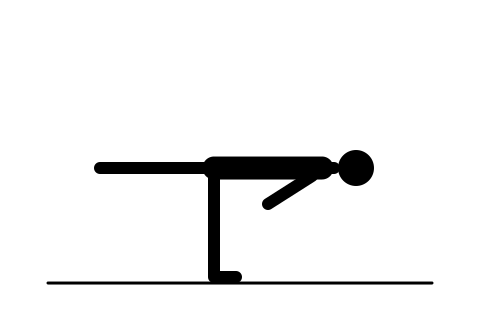
In the diagram the torso and the lifted leg lie on one line, but it is a reference and not a required goal. In the full shape it is easy to lose the position of the pelvis: the thigh of the lifted leg turns outward and the lower back arches. If that happens, lower the leg and return to a smaller lean.
The standing leg works all the time, so a slight tremor in the foot and the knee is a normal part of finding balance. A wall or a chair is not a weaker version: support lets you focus on the pelvis and the breath. Ask a teacher to look from the side and say whether the lower back sags.
How to do it
- Stand in mountain at arm's length from a wall. Move the weight onto the right foot and keep the left foot beside it. The standing knee is slightly soft and the pelvis faces straight ahead.
- Place the hands on the hips or on the wall in front of you. Choose a still point on the floor and look at it: it is easier to keep the balance.
- On an exhalation lean the torso forward and send the left leg back. Move both together and in a small range while the pelvis stays level, without opening the hip to the side.
- Stop where you can breathe calmly. The heel of the lifted leg reaches back and the toes point to the floor. Take two or three breath cycles.
- Inhale, slowly return to mountain and rest. Repeat on the other side; if one side is steadier, that is an ordinary difference.
Common mistakes
- Letting the pelvis tip to the side and lifting the leg higher than the torso allows. Lower the leg and keep the pelvis level: the line does not have to be horizontal.
- Locking the standing knee and looking forward with the head thrown back. Keep the knee soft and the neck a continuation of the spine.
How to make it easier
- Keep the hands on the wall or on the back of a chair and hold the lifted leg low, with the toes almost touching the floor. The lean of the torso may be small.
- Practise with the toes of the lifted leg on the floor or on a block behind you. The breath stays even, so the full shape is not needed.
When to skip it and ask a doctor first
- With pain in the knee, ankle, lower back or back of the thigh, do not deepen the lean and choose the wall version. After an injury or an operation, ask a doctor first which load is suitable.
- During pregnancy, with dizziness or blood pressure problems, practise only with support and talk through the version with a teacher. Sharp pain and numbness are reasons to stop.
Where it appears
In hatha the pose is usually taught after Warrior I and Warrior II: the legs and the pelvis are already familiar from them. Before it, it helps to practise one-leg steadiness in Tree. In vinyasa Warrior III sits in a sequence between lunges and can be replaced by a pause in mountain. Drishti is a calm gaze at a point on the floor. Begin with a short hold and rest between the sides. If the balance does not come, stay with the wall for as long as needed.
Aura Editorial · updated November 15, 2026