- Sanskrit
- Utthita Parsvakonasana
- In Russian
- Уттхита паршваконасана (вытянутый боковой угол)
- In English
- Utthita Parsvakonasana (Extended Side Angle)
A hand on the thigh is also the pose
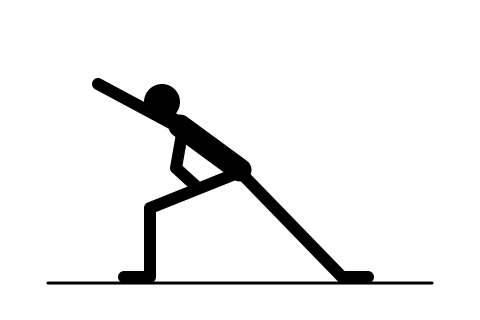
In the diagram the forearm rests on the thigh, and this is not a simplification for beginners but a working version. The floor is far for many people: a block or the thigh keeps the torso open. The knee over the foot matters more than depth: make sure it does not drift inward and that the weight stays on both legs.
The upper arm reaches in one line with the back leg, but the line should not press on the neck. If the shoulder rises towards the ear, lower the arm to the hip. Ask a teacher to look from the front: is the torso collapsed, does the back heel stay on the floor?
How to do it
- Stand in a wide stance as for Warrior II: the front foot points forward and the back foot turns slightly in. Reach the arms out to the sides at shoulder height.
- Bend the front knee over the foot so that it faces the same way as the toes. If the knee drifts inward, shorten the stance or bend the leg less.
- Lean the torso towards the front leg and rest the lower forearm or palm on the thigh. For support nearer the floor, place a block outside the front foot.
- Extend the upper arm by the ear or leave it on the hip. Look forward or down so the neck stays relaxed, and take three or four calm breaths.
- Straighten the front leg, lift the torso and lower the arms. Repeat on the other side.
Common mistakes
- Pressing the elbow into the thigh and collapsing the chest downwards. A light touch is enough: the torso stays open and the breath free.
- Squeezing the shoulders and throwing the head back to look at the hand. Direct the gaze forward or down.
How to make it easier
- Leave the lower hand on the thigh and the upper hand on the hip. A smaller lean and a shorter stance are a complete version.
- Place the lower palm on a high block or a chair outside the foot. Choose a height at which the back stays even.
When to skip it and ask a doctor first
- With pain in the knee, hip, lower back or neck, do not hold the pose. After an injury or an operation, ask a doctor first which standing poses suit you.
- With dizziness, low blood pressure and during pregnancy, practise beside a wall together with a teacher. A sharp sensation is a reason to leave the pose at once.
Where it appears
In hatha the pose is taught after Warrior II: the legs are the same and the lean of the torso changes. Related poses are Triangle, where the legs are straight, and Half Moon, where the back leg lifts. Drishti is a calm gaze that helps keep the shape. Begin with one side, stand on both feet and breathe evenly before moving to the other.
Aura Editorial · updated November 15, 2026