- Sanskrit
- Ardha Chandrasana
- In Russian
- Ардха чандрасана (полумесяц)
- In English
- Ardha Chandrasana (Half Moon)
A block makes the pose accessible
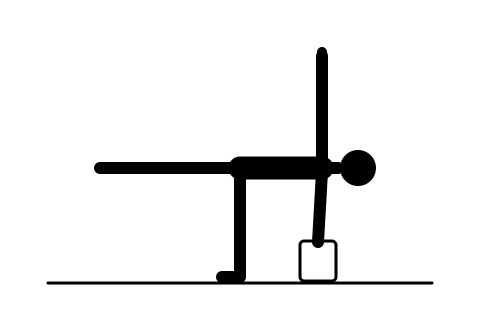
In the diagram the hand almost touches the floor, but that is not a requirement. The block goes higher if the floor is too far. It is not a concession but a way to keep the torso open and the back even. If the knee of the standing leg locks, bend it slightly more.
The lifted leg helps balance the torso, not the other way round. Move slowly and look at a steady point. Ask a teacher to look from behind: does the pelvis drop, and do the shoulders stay in one line?
How to do it
- Stand with your back to a wall and place a block near the right foot. From triangle pose with the right leg forward, bend the right knee.
- Place the right palm on the block in front of the foot, about a hand's length away. Shift the weight onto the right leg and keep the knee soft.
- Straighten the right leg and raise the left to hip height without tipping the torso. The left heel reaches towards the wall, with the toes pointing forward.
- Raise the left arm and open the chest. Look forward, or at the floor if the neck tires, and take three or four calm breaths.
- Bend the right knee, place the left leg on the floor and return to standing. Rest and repeat on the other side.
Common mistakes
- Reaching the palm to the floor too far from the foot. Raise the block: the support should be close and stable.
- Dropping the pelvis forward and holding the breath. If balance drifts, lower the lifted leg and place it on the floor.
How to make it easier
- Do not lift the leg above the knee of the standing leg and keep the toes of the lifted leg on the floor. Leave the hand on the hip.
- Practise with the back against a wall: touch the wall with the buttock and the heel of the lifted leg. Place the block higher.
When to skip it and ask a doctor first
- With pain in the knee, ankle, hip or lower back, do not hold the pose. After an injury or an operation, ask a doctor first what load is suitable.
- With dizziness, loss of balance, low blood pressure, and during pregnancy, practise only beside a wall together with a teacher. A sharp sensation is a reason to leave the pose at once.
Where it appears
In hatha, Half Moon is taught after Triangle: the legs are similar and the torso stays in the same plane. In vinyasa it serves as a balance between standing poses. Related poses are Tree and Eagle. Drishti here is a calm gaze that helps keep balance. Begin with a short hold beside a wall.
Aura Editorial · updated November 15, 2026