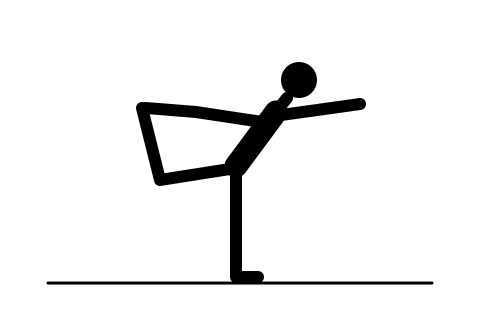
- Sanskrit
- Natarajasana
- In Russian
- Поза танцора (Натараджасана)
- In English
- Natarajasana (Dancer pose)
Stretch without jerks
The name suggests a deep backbend and a high leg, but in the diagram the torso leans moderately and the foot rests in the hand without force. The standing leg, the thigh of the lifted leg and the shoulder work together, and the whole shape is built from small movements. If the leg is high and the pelvis rotates, reduce the depth.
A strap lengthens the arm and lets you hold the foot without tension in the shoulder. A wall helps check that the pelvis stays level and does not drift away. Ask a teacher to look from the side: does the lower back arch, does the pelvis face forward?
How to do it
- Stand in mountain beside a wall and place the left hand on it. Move the weight onto the left foot, keep the standing knee soft and the pelvis level.
- The left hand stays on the wall. Bend the right knee and loop a strap around the right foot; the right hand holds the strap or, if it reaches, the foot without a jerk.
- Draw the foot back, not up, and lean the torso slightly forward. The knee of the lifted leg stays close to the standing leg and the lower back does not arch.
- The left hand stays on the wall or reaches forward. Look at a still point and take two or three calm breath cycles.
- Release the strap, return to mountain and rest. Repeat on the other side; a difference between the sides is common.
Common mistakes
- Pulling the foot up with force and arching the lower back. Lower the leg, lean less and lengthen the strap.
- Turning the pelvis and letting the thigh drift to the side. Level the pelvis and keep the knee of the lifted leg beside the standing one.
How to make it easier
- Hold the foot with the hand while the torso stays upright and keep the other hand on the wall. The lean may be barely visible.
- Leave the toes of the lifted leg on the floor behind you and reach the arm forward. When the breath is even, lift the leg a little higher.
When to skip it and ask a doctor first
- With pain in the knee, hip, lower back or shoulder, do not deepen the backbend and choose the version with a wall and a strap. After an injury or an operation, ask a doctor first which backbends are suitable.
- During pregnancy, with dizziness or blood pressure problems, practise only with support and agree on the version with a teacher. Numbness and sharp pain are reasons to stop.
Where it appears
In hatha the pose is taught after balances on one leg: first Tree, then Eagle and Half moon. They teach steadiness in the support and the position of the pelvis. In vinyasa Dancer appears in the middle of a class and can be replaced by Tree. Drishti is a calm gaze forward. Begin with a short hold and change sides while the breath is even. If the balance does not come, stay with the wall and the strap for as long as needed.
Aura Editorial · updated November 15, 2026