- Sanskrit
- Garudasana
- In Russian
- Гарудасана (орёл)
- In English
- Garudasana (Eagle)
Balance and wrapping
The main task here is steadiness. Wrapping the legs and arms adds difficulty, so every step can be made simpler. The knees are slightly bent, so the knee of the standing leg is not locked. If the leg does not wrap around, that is a feature of mobility, not a mistake.
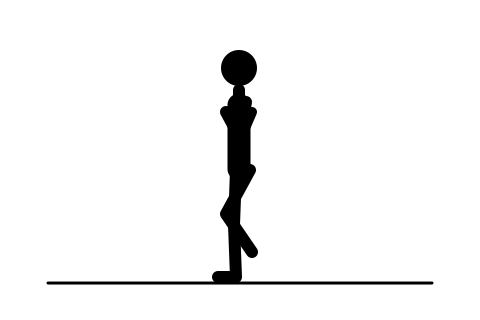
The diagram shows the version with the wrapped leg and crossed arms. It is not a model for everyone. Ask a teacher to look from the front: does the knee stay over the foot, and does the pelvis drift sideways? Short holds with a calm exit are better than one long one.
How to do it
- Stand beside a wall or a chair. Bend the knees slightly, as in chair pose, and shift the weight onto the left leg, keeping the knee soft.
- Lift the right leg and place it over the left at thigh level. If wrapping does not work, keep the toes of the right foot on the floor beside the left.
- Cross the arms in front of the chest: right over left, elbows bent. If the palms do not meet, hold the backs of the hands together or rest the hands on the shoulders.
- Lift the elbows to shoulder height without pressing the shoulders towards the ears. Look at a fixed point ahead and take three even breaths.
- Slowly unwind the arms, place the right foot on the floor and return to standing. Repeat on the other side.
Common mistakes
- Twisting the knee of the lifted leg hard and pressing on the joint. It is enough to lay the leg over, and with any discomfort keep the toes on the floor.
- Swaying and holding the breath to stay up. If balance is lost, place the foot on the floor and start again.
How to make it easier
- Keep the toes of the lifted leg on the floor with the thighs crossed. Hold your own shoulders with the arms instead of wrapping them.
- Do the pose seated on a chair: cross one leg over the other, cross the arms in front of the chest and lengthen the spine slightly.
When to skip it and ask a doctor first
- With pain in the knees, ankles or hips, do not hold the pose. After an injury or an operation on the leg, ask a doctor first what load is suitable.
- With dizziness, frequent loss of balance, a risk of falling, and during pregnancy, practise only beside a wall or seated together with a teacher. A sharp sensation is a reason to leave the pose at once.
Where it appears
In hatha, Garudasana sits among the balance poses, usually after Tree or Chair. In vinyasa it is convenient between dynamic blocks. Half Moon is close in character. Drishti is a fixed point for the eyes that helps keep balance. After finishing one side, rest standing and compare the sensations.
Aura Editorial · updated November 15, 2026