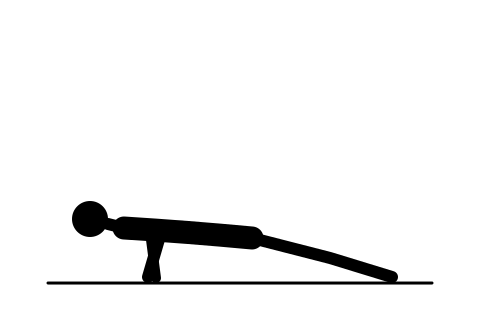
- Sanskrit
- Chaturanga Dandasana
- In Russian
- Чатуранга дандасана
- In English
- Chaturanga Dandasana
Height matters more than depth
Chaturanga appears in vinyasa sequences between plank and upward-facing dog, so it is often done quickly. The faster it goes, the more often the shoulders sink. If the shape cannot be held yet, replace the pose by lowering to the knees or to the belly: this is an ordinary option, not a concession.
The position of the hands decides the load on the wrists. Spread the weight over the whole palm, especially the base of the index finger and thumb. Look at the floor slightly ahead of the hands so the neck continues the line of the back.
How to do it
- Come into plank with straight arms: palms under the shoulders, fingers spread, the body in one straight line. Lower the knees to the mat if you need to.
- Shift the weight slightly forward so the shoulders are over the wrists or just ahead of them. Keep the abdomen engaged; the pelvis neither sags nor lifts.
- On an exhalation, begin to bend the elbows. Keep them close to the ribs and point them back, not out to the sides.
- Stop when the elbows are bent at about a right angle and the shoulders are at the height of the elbows. Do not go lower: at this height the chest stays open and the neck long.
- Inhale and press the arms straight back into plank, or lower the knees and chest to the floor. Rest in child's pose before repeating.
Common mistakes
- Letting the shoulders drop below the elbows or letting the elbows flare out. Stop higher: this keeps the work in the chest and arms rather than the shoulder joints.
- Letting the pelvis sag or lift. Draw the abdomen in, and if you cannot hold the line, lower the knees.
How to make it easier
- Practise on the knees: the body forms a straight line from the knees to the head, and the elbows bend only a little.
- Do the movement standing at a wall: palms on the wall, elbows bend, the torso leans towards the wall and returns.
When to skip it and ask a doctor first
- With pain in the wrists, elbows or shoulders, do not hold the pose. After an injury to the hand or shoulder, or an operation, ask a doctor first how much load on the arms is suitable.
- During pregnancy, with weak abdominal muscles or lower back pain, choose the knees-down or wall version together with a teacher. A sharp sensation is a reason to leave the pose at once.
Where it appears
In vinyasa, chaturanga belongs to the sun salutation: after plank comes the lowering, then upward-facing dog or cobra, then downward-facing dog. In hatha it is more often taught on its own, without the transition. Drishti helps keep the head level. Learn the shape slowly with a teacher before adding speed.
Aura Editorial · updated November 15, 2026