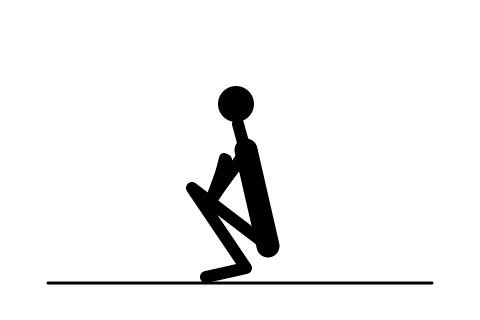
- Sanskrit
- Malasana
- In Russian
- Маласана (поза гирлянды)
- In English
- Garland pose (Malasana)
Support under the heels is an ordinary choice
In the diagram the heels rest on the floor. For many people this is out of reach: the ankles limit the depth of the squat. A blanket under the heels or a high block under the pelvis does not shrink the pose; it keeps the spine calm and the knees steady. Choose the width of the feet by comfort, not by a photograph.
There is no need to hold the pose for as long as possible. A few breaths are enough for a first acquaintance. If breathing becomes strained, you lose balance or the knees feel pressure, straighten the legs and walk around.
How to do it
- Stand on the mat with the feet a little wider than the pelvis and the toes turned slightly out. If the heels lift at once, place a folded blanket or a rolled mat under them.
- Bend the knees and lower slowly until the pelvis is between the heels or at a comfortable height above the floor. Point the knees towards the toes and do not let them fall inwards.
- Bring the palms together in front of the chest. Press the elbows gently against the inner knees and the knees against the elbows while keeping the spine upright. You can leave the hands on the floor if that feels better.
- Look ahead and breathe normally without holding the breath. Stay for a few breaths, adjusting the pelvis if needed. If the pose gets in the way, rise earlier.
- To leave, press the hands into the floor and straighten the legs into a forward bend. Then raise the torso slowly with a rounded back. Pause and shake out the legs if they feel numb.
Common mistakes
- Trying to lower the heels to the floor at any cost, which sends the knees inwards or strains the lower back. Place support under the heels and narrow the feet.
- Staying in the squat when the legs go numb or the knees feel pressure. Rise, shake the legs out and return to a higher position or choose an easier option.
How to make it easier
- Sit on a block or a stack of books between the feet so the pelvis is higher. The hands stay on the floor or on the knees and the knees stay apart; the support can be lowered gradually or left as it is.
- Lean the back against a wall and slide down it with a blanket under the heels. If the knees bother you, replace the squat with sitting on a chair with the legs wide apart.
When to skip it and ask a doctor first
- Do not practise this pose with pain in the knees, ankles, hips or lower back, or with numbness or tingling in the legs. Rise and tell a doctor about the sensations if they repeat.
- During pregnancy, after recent surgery or injury to the legs or pelvis, and with any limit on deep knee bending, ask a doctor first. Pass the advice to your teacher and choose a high support.
Where it appears
In hatha, Malasana appears in the lower part of a class, before sitting or after forward bends; in vinyasa it is used as a transition. Asana names the position and drishti describes the gaze, which here is directed forward. Find a hatha teacher who will explain how to choose support under the heels and how to come out of the squat before you repeat the pose on your own.
Aura Editorial · updated November 13, 2026