- Sanskrit
- Janu Sirsasana
- In Russian
- Джану ширшасана (голова к колену)
- In English
- Janu Sirsasana (Head to Knee)
The bend starts at the hips
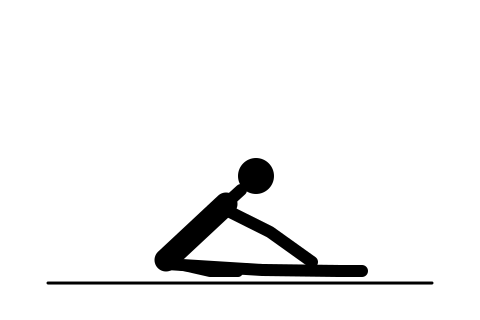
The name Head to Knee creates an expectation that need not be met literally. In the diagram the torso leans at a small angle and the hands rest on the leg without pulling. If the back rounds, sit higher: a support under the pelvis helps keep the spine long.
The bent leg adds a small asymmetry, so the pelvis tends to slide to one side. Level it with a support under the knee. Ask a teacher to look from the side: does the pelvis sink, does the extended knee stay soft, do the shoulders tense? The breath stays calm.
How to do it
- Sit on the edge of a folded blanket and extend the right leg forward. Bend the left knee and move it out to the side, placing the sole of the left foot against the inner right thigh.
- If the left knee hangs in the air, place a bolster or a folded towel under it. Keep the right knee soft and the toes pointing up.
- On an inhalation lengthen the spine upward; on an exhalation begin the bend from the hips, not from the head. Rest the hands on the thigh or the shin without pulling yourself in by the foot.
- Stop where the breath stays even and take three or four cycles. Look forward or down; the neck stays a continuation of the spine.
- On an inhalation slowly lift the torso, change the position of the legs and repeat on the other side.
Common mistakes
- Pulling the head towards the knee and rounding the back. Reduce the bend and add a support: an even back matters more than depth.
- Straightening the knee fully and reaching for the foot. Keep the knee soft; the hands should not fight resistance.
How to make it easier
- Sit higher on a firm blanket and rest the palms on the thigh of the extended leg. The bend may be almost unnoticeable.
- Bend the extended leg and place a bolster under the knee. Support the hands on a block or a cushion in front of you.
When to skip it and ask a doctor first
- With pain in the lower back, knee or back of the thigh, do not deepen the bend. After an injury or an operation, ask a doctor first which bend is suitable.
- During pregnancy, agree on room for the torso with a teacher and choose a pose with the legs wide apart. Numbness and a sharp pulling sensation are reasons to stop.
Where it appears
In hatha the pose is usually taught after Seated forward bend: the legs are the same but one is bent. Bound angle and Easy pose prepare the sitting position and the pelvis. In vinyasa it serves as a calm pause between dynamic poses. Drishti is a calm gaze forward. Begin with a short hold and move to the second side when the breath stays even.
Aura Editorial · updated November 15, 2026