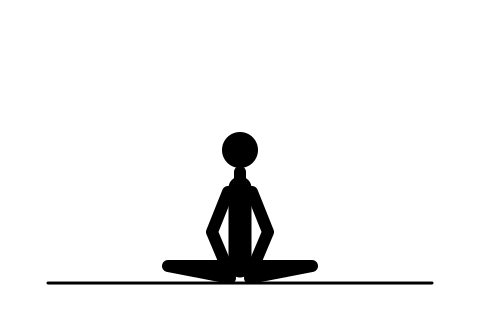
- Sanskrit
- Baddha Konasana
- In Russian
- Баддха конасана (бабочка)
- In English
- Baddha Konasana (Bound Angle)
What the diagram shows
The drawing shows a calm shape: a straight back, soles together and knees open without trying to reach the floor. Hip joints differ from person to person, so the same picture looks different on two people. The distance between the knees and the mat is not something to compare with others.
Notice what you actually feel. A gentle stretch along the inner thighs is acceptable, while compression in the groin, knee or lower back means the support should change. Hold the feet without jerking. Look down in front of you: drishti here helps keep the neck from reaching forward.
How to do it
- Sit on a folded blanket or firm bolster so the pelvis is higher than the knees. Extend the legs forward and find your weight on the sitting bones rather than on the sacrum.
- Bend the knees and bring the soles of the feet together in front of the pelvis. Leave the heels at a distance where the thighs and groins stay soft; there is no need to pull them closer.
- Hold the feet or shins with your hands. Lengthen the spine from the pelvis to the crown of the head and let the shoulders soften, without squeezing the shoulder blades together.
- Let the knees lower by themselves, without pressing with the hands and without bouncing. If the knees stay high, place a block or rolled towel under each one.
- Breathe calmly for a few cycles, then lift the knees with your hands, extend the legs forward and shake them out. Rest before moving to a forward bend or another pose.
Common mistakes
- Pressing the knees towards the floor with hands or elbows and bouncing. The stretch along the inner thighs should feel gentle; the knees lower through release, not through force from the arms.
- Sitting on the floor with a rounded lower back and pulling the head towards the feet. Place support under the pelvis instead: a straight spine matters more than leaning the torso forward.
How to make it easier
- Sit on a high cushion and place blocks or pillows under the knees. Support lets the thighs relax, so the pose can be held without strain.
- Move the feet further away from the pelvis or extend one leg. If the position is still uncomfortable, replace it with an easy cross-legged seat.
When to skip it and ask a doctor first
- With pain in the knees, hips or groin, do not hold the pose. After an injury or an operation on the legs, ask a doctor first which positions are suitable.
- During pregnancy, with lower back pain or numb legs, choose a high-support version together with a teacher. A sharp sensation is a reason to leave the pose at once.
Where it appears
In hatha, Bound Angle often comes early in the class to prepare the hips for other seated shapes. In vinyasa it serves as a pause between dynamic blocks. The pose pairs well with Cow Face and with easy pose. If you want to prepare the hips, agree on the sequence with a teacher and begin with a short hold.
Aura Editorial · updated November 15, 2026