- Sanskrit
- Mandukasana
- In Russian
- Мандукасана (поза лягушки)
- In English
- Mandukasana (Frog pose)
You choose the width of the knees
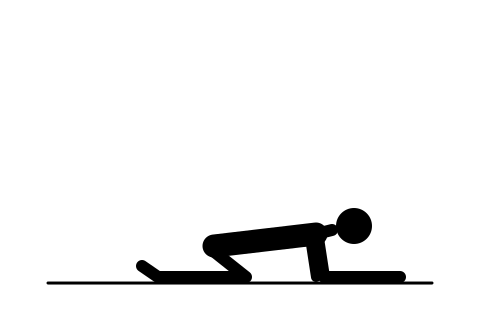
The name suggests a deep pose with horizontal thighs, but in the diagram the knees are moderately apart and the pelvis stays above them. Feel the stretch of the inner thighs as a gentle pull, not as pressure in a joint. If the feeling turns sharp, bring the knees closer.
Knees and ankles on a hard floor are easily overloaded, so a blanket is part of the pose and not a concession. The feet point outward and the shins rest on the mat. Ask a teacher to look at whether the pelvis drifts forward and whether the lower back arches.
How to do it
- Come onto hands and knees on a mat and place a folded blanket under the knees. If the wrists tire, lower the torso onto the forearms.
- Move the knees apart to a comfortable width, no more. Turn the toes out so the shins rest on the floor and the ankles stay soft.
- On an exhalation draw the pelvis back while staying above the knees. Keep the back long, the neck a continuation of the spine and the gaze on the floor in front of you.
- Stop where the breath is calm and take three or four cycles. If the knees or the inner thighs object, bring the knees closer together.
- On an exhalation bring the knees together, sit gently on the heels and rest in Child's pose. Rise slowly.
Common mistakes
- Moving the knees as wide as possible and enduring pressure in the knees. Bring the knees closer and add padding: width does not show the quality of the pose.
- Arching the lower back and lowering the chest to the floor while leaning on the neck. Keep the torso long and shift the support to the forearms.
How to make it easier
- Place a bolster or a cushion under the pelvis and the chest. The knees can move apart just a little while you stay on hands and knees.
- Replace the pose with a seated Bound angle on a support or Child's pose with wide knees. It is not weaker, just kinder to the knees.
When to skip it and ask a doctor first
- With pain in the knees, hips, groin or lower back, do not move the knees wider and choose a version with padding. After an injury or an operation, ask a doctor first which opening is suitable.
- During pregnancy, with numb legs or sharp pain, do not practise the pose from general instructions. Agree on a version with a teacher and a doctor.
Where it appears
In hatha the pose is usually taught after Bound angle and the squat Garland: they prepare the hips and the position of the pelvis. It is convenient to finish with a rest in Child's pose. In vinyasa Frog appears towards the end of a class and can be replaced by any calm seat. Drishti is a calm gaze at the floor. Begin with a short hold and do not aim for width.
Aura Editorial · updated November 15, 2026