- Sanskrit
- Hanumanasana
- In Russian
- Хануманасана (шпагат)
- In English
- Hanumanasana (splits)
The splits do not measure practice
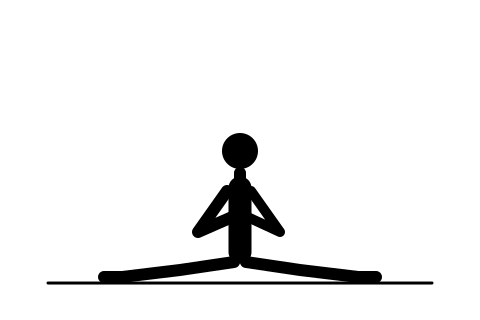
In the diagram the torso is upright and the legs lie on the floor in one line. It is a shape many people will not reach, and that is normal: hip mobility depends on the structure of the body, not on effort. A sudden stretch of the back of the thigh and the groin raises the risk, so blocks set the depth, not a goal.
The pelvis should stay above its support and not sink to the floor. If the pelvis drifts to the side or the knee turns, choose a higher support. Rehearse the entry and exit with a teacher before the first attempt and agree on a signal that means stop.
How to do it
- Begin in [Low lunge](/asanas/low-lunge) with the right foot forward and the left knee on a folded blanket. Place blocks on both sides of the foot and rest the palms on them.
- On an exhalation move the pelvis back slightly and straighten the front leg, keeping the knee soft. The heel stays on the floor and the toes point up.
- Stop where the breath stays even. The pelvis faces forward, the torso lengthens upward and the blocks under the hands carry the weight.
- Do not aim to go lower. If a sharp sensation appears in the back of the thigh, the knee or the groin, step back; do not extend the duration through pain.
- Come out the way you came in: return to Low lunge and rest in [Standing forward bend](/asanas/standing-forward-bend) with soft knees. Then repeat on the other side.
Common mistakes
- Dropping into the position under body weight and treating depth as a measure of practice. Raise the blocks and keep the pelvis above the floor: support matters more than depth.
- Turning the pelvis to the side and straightening the knee fully. The knee stays soft and the pelvis faces forward.
How to make it easier
- Stay in Low lunge with blocks under the hands and the knee on a blanket. It is not a step on the way but a pose in its own right.
- The front leg can stay bent and the support under the palms high. Place folded blankets under the pelvis and thighs if support is needed.
When to skip it and ask a doctor first
- Do not practise the pose with pain in the groin, the back of the thigh, the knee or the lower back, or after a recent injury or operation. Ask a doctor first which stretch is suitable.
- During pregnancy, with numb legs or sharp pain, do not learn the pose from general instructions. Agree on practice with a doctor; a sharp sensation means stopping at once.
Place in a class
In hatha the pose is placed towards the end of a class, after Low lunge and Standing forward bend. Hip opening can be prepared with Pigeon. In vinyasa a low lunge is chosen instead of the splits. Drishti is a calm gaze forward. Begin with a short hold, rest between the sides and compare the sides without judgement.
Aura Editorial · updated November 23, 2026